


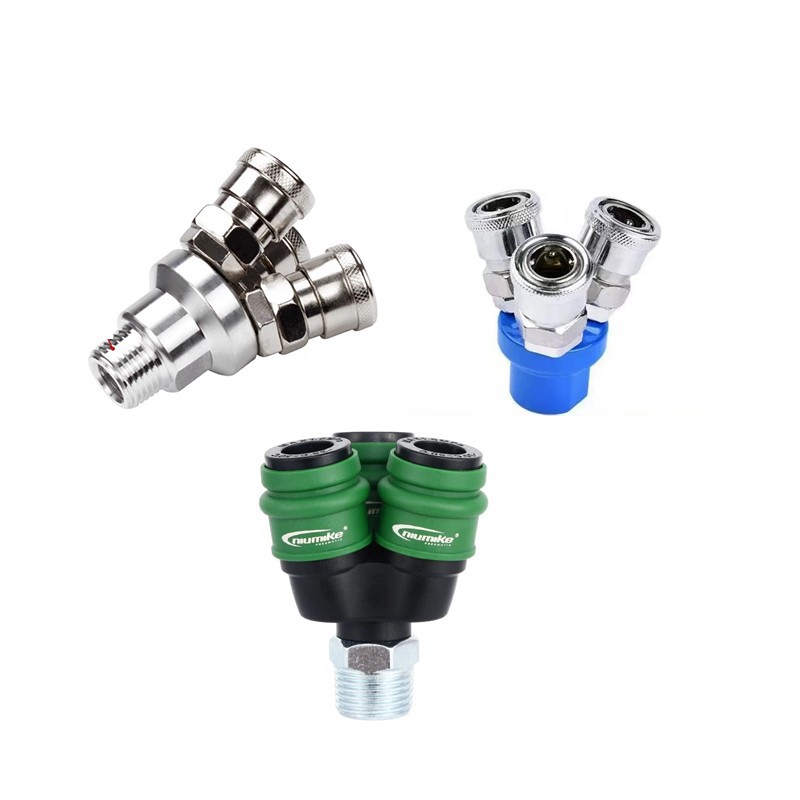


Structure Type

Structure: The tracheal tee joint usually consists of a main body and three connection ports. The body has channels inside that enable the gas or fluid to flow between the three ports. The size and shape of the three ports vary according to different specifications and uses, the common ones are equal diameter tee and variable diameter tee, the three ports of equal diameter tee have the same diameter, and the variable diameter tee has different diameter combinations.
Type: In terms of shape, it is mainly divided into Y type and T type. The three ports of the Y-shaped tee connector are distributed in a Y-shape, which is generally used to divide one airflow into two or merge two airflows into one; Shaped like the letter T, a T-shaped tee is typically used to lead a branch pipe into a main pipe for the distribution or confluence of airflow.
Made of metal
Brass: Tee joints have good strength, have a certain corrosion resistance, after nickel plating and other surface treatment, can further improve their corrosion resistance and aesthetics, often used in pneumatic systems with certain requirements for corrosion resistance and strength, such as pneumatic pipeline connections in industrial automation equipment.
Stainless steel: such as 304, 316 and other stainless steel materials, with excellent corrosion resistance, high temperature resistance and high strength, can adapt to a variety of complex working environments, can be used in chemical, medical, food and beverage and other industries with high requirements for hygiene and corrosion resistance

peculiarity

Convenient connection:
The tee joint mostly adopts the quick-plug design, which can insert the air pipe into the joint without tools to complete the connection, which is quick and easy to install, can effectively improve work efficiency, and is convenient for equipment maintenance and overhaul.
Reliable sealing:
The use of advanced sealing structures and materials, such as rubber sealing rings, NBR, FKM and other materials of O-rings, can ensure that the gas leakage is effectively prevented after connecting the air pipe, and ensure the stability and reliability of the pneumatic system.


Flexible angle:
The exit angle of some tee joints can be changed after installation, and the air pipe direction can be flexibly adjusted through different combinations of threaded parts and resin fitting bodies, which is convenient for compact and dense pipe layout.
Strong compatibility:
It can be used well with pipe fittings and pneumatic components of the same brand or other brands, which is convenient for building a complete and unified pneumatic system.

FAQ
Q: What parameters should be checked if the dimensions do not match when the air duct is assembled?
A: The outer diameter tolerance of the air duct, the diameter of the joint and the flatness of the flange plane.
Q: Cracks on the inner wall after long-term use, what are the common problems?
A:The material has insufficient fatigue resistance, frequent fluctuations in wind pressure or concentrated stress during installation.
Q: After installation, the resistance at the tee increases abnormally, what factors should be investigated?
A: There is a foreign object blockage inside, the deviation of the branch angle is too large, or the pipe diameter transition is unreasonable.
Hot Tags: duct tee joints, China duct tee joints suppliers


