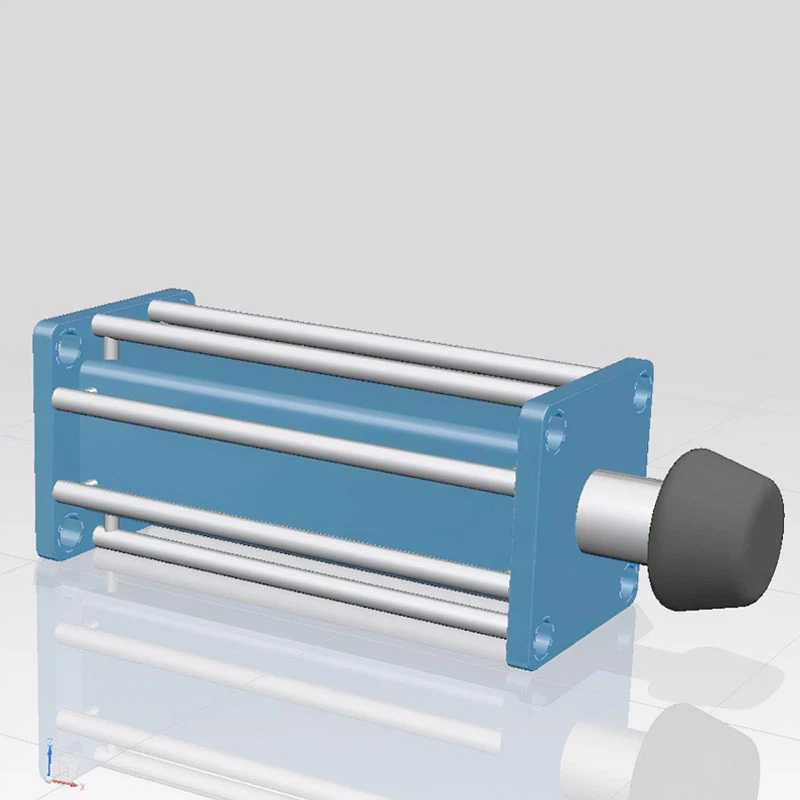
Structural composition
Cylinder barrel: It is the main part of the cylinder, usually cylindrical, and the size of the inner diameter determines the output force of the cylinder. The piston slides on its smooth inner surface, and the roughness of the inner surface is generally required to reach Ra0.8μm to ensure the stability of the piston movement
End caps: Installed at both ends of the cylinder barrel, they are provided with intake and exhaust ports, and some end caps are also provided with buffer mechanisms to slow down the impact of the piston at the end of the stroke. Seals, wipers and guide sleeves are also usually provided on the rod side end caps to prevent air leakage, dust and improve the guiding accuracy of the cylinder.
Piston: It is a key part of the cylinder to withstand pressure, and the piston sealing ring prevents the left and right chambers from blowing each other. The wear ring on the piston can improve the guiding property of the cylinder, reduce the wear of the piston sealing ring, and reduce the frictional resistance, and its material is often polyurethane, polytetrafluoroethylene, etc.
Seal: It is used to prevent the leakage of compressed air in the cylinder and ensure the working efficiency and performance of the cylinder. Common sealing materials are rubber, polyurethane, etc., and the seals are installed in the fitting parts of the piston, piston rod and cylinder barrel and end cover.


How it works
Single-acting cylinder: Only one chamber can be fed with compressed air to achieve movement in one direction, and its piston rod can only be pushed back by external force, usually with the help of spring force, diaphragm tension or gravity, etc. For example, in some simple clamping devices, a single-acting cylinder pushes the piston rod out of the clamping workpiece by compressed air, and then relies on spring force to retract the piston rod and loosen the workpiece.
Double-acting cylinder: The two chambers can be separately fed with compressed air to achieve two-way movement. When the compressed air enters one chamber of the cylinder, the piston is pushed to move to the other side, and the gas of the other chamber is discharged at the same time; Conversely, when the compressed air enters the other chamber, the piston moves in the opposite direction. For example, in automated production lines, double-acting cylinders can be used to move workpieces between stations.
peculiarity
Simple structure: It is composed of basic components such as cylinder barrel, piston, piston rod, seal, etc., without complex transmission mechanism, easy to manufacture, install and maintain, and low cost.
Stable output force: The double-acting cylinder can provide stable push and pull force, and the output force can be accurately controlled by adjusting the air pressure and piston area to meet the needs of different working scenarios.
Adjustable stroke: The stroke length of the standard cylinder can be selected according to the actual needs, and the flexible adjustment of the stroke can be realized by replacing the piston rod of different lengths or adjusting the length of the cylinder barrel to meet various work requirements
Strong adaptability: suitable for a variety of industrial environments and automation equipment, can adapt to different installation methods and environmental conditions, such as high temperature, low temperature, humidity, dust and other environments, as long as the appropriate materials and protective measures are selected, the normal operation of the cylinder can be guaranteed.

FAQ
Q: What are the operating conditions for standard cylinders?
A: It is suitable for scenarios with medium loads (thrust 500-5000N) and flexible stroke requirements (10-2000mm), such as machine tool feeding, stamping assistance and other general automation fields.
Q: What are the installation options?
A:It can be installed in a variety of ways such as front flange, rear flange, trunnion, tail suspension, etc., to meet the needs of different space layouts.
Q: What is the maintenance focus?
A: Regularly check the piston rod for scratches, maintain air source filtration (accuracy ≥ 5μm), and replace the seal in time after wear.
Hot Tags: standard cylinders, China standard cylinders suppliers